Google has over 200 million active websites on the platform, which it uses to power its search results. To rank your new website on Google in 6 months, businesses need to focus on technical website health, strong keyword strategy, and consistent quality content publishing. Professional SEO agencies like IndeedSEO ensure that growing businesses optimize websites to improve search visibility and online presence.
Follow this SEO guide to improve Google rankings, drive targeted traffic, and build a stronger brand within the first six months.
What Factors Does Google Consider To Rank New Websites
Understanding how Google decides which website to rank higher is important to make the right optimization strategy. To rank a brand-new website, Google focuses more on user trust, technical website health, and content relevance. Core ranking factors to target if you are wondering how to rank on Google fast include:
Search Intent:
Google’s primary goal is to show top pages that match a user’s search query. Before creating content, understand what users are searching for. Websites should ensure every page targets accurate keywords in the content naturally.
The four primary types of search intent are:
- Informational
- Navigational
- Commercial
- Transactional
A strong content strategy is required to target every intent effectively.
Start Building Long-Term Organic Growth Today with IndeedSEO
Query Examples
Informational: “What is SEO?”
Navigational: “Ahrefs login”
Commercial: “Best SEO tools for small businesses”
Transactional: “Hire SEO agency”
Information Gain:
Google rewards unique content that offers the latest information. Adding original research and real examples increases the value of your content, which helps your website rank higher.
Example Query – “What is technical SEO?”
Instead of defining technical SEO, include a real website audit example and unique tips where users can understand and use the information effectively.
E-E-A-T:
Google expects websites to have hands-on experience and expertise around the topic they cover. Publishing accurate information and citing reliable sources helps to strengthen E-E-A-T signals.
What to use:
- Experience: Firsthand personal use or hands-on testing.
- Expertise: Formal credentials, degrees, or professional qualifications.
- Authoritativeness: Recognition, links, and citations from industry peers.
- Trustworthiness: Transparency, cited facts, and verified site safety.
Authority and Structure
Website authority is a key ranking factor that helps brands establish their trust. Top authority improvement factors include:
Initial Backlinks:
A clear website structure helps Google understand the relationship between its website pages. Backlinks earned from reputable websites help establish credibility. Quality backlinks help to improve search visibility and strengthen brand trust. Websites must have a few quality backlinks rather than multiple low-quality links.
Internal Linking:
Internal Linking is required to connect related service pages, building clear text pathways and setting up keyword links to distribute page authority efficiently. This clear layout guides crawlers through your content, helping with indexing speeds and boosting site credibility.
Crawlability:
Search Engine Optimization specializes in technical site health configuration. Daily backend operational tasks involve patching dead web links, rewriting indexing directive files, filtering out duplicate page layouts, and validating structural URLs for live crawl bot access. Submit XML sitemaps in Google Search Console to ensure your important pages can be indexable.
User Experience and Technical Performance
Google favors websites that provide fast and user-friendly browsing. Visitors should be able to scroll on your website while avoiding slow-loading pages or intrusive pop-ups.
Core Web Vitals:
Core Web Vitals measure how quick and smooth your users’ interaction is. Google checks your website loading performance and responsiveness to assess the page quality. Optimizing these metrics creates a better browsing experience while supporting higher rankings.
How to Target
- Compress images
- Minimize JavaScript
- Enable browser caching
- Improve server response time
- Optimize page layouts for faster loading
Mobile-Friendliness:
Google primarily indexes a website’s mobile version. Every page should adapt to different screen sizes with fast speed and easy navigation, making it more user-friendly.
HTTPS Security:
Website security is an important Google ranking factor. HTTPS encrypts data between your website and visitors, protecting sensitive information and improving user trust.
To summarize: Google ranks new websites by evaluating search intent, content quality, and E-E-A-T strength. While domain age itself is not a direct metric, new sites can prove their content value to send high authority signals to Google and rank higher than competitors.
The 6 Month SEO Timeline to Rank a New Website on Google
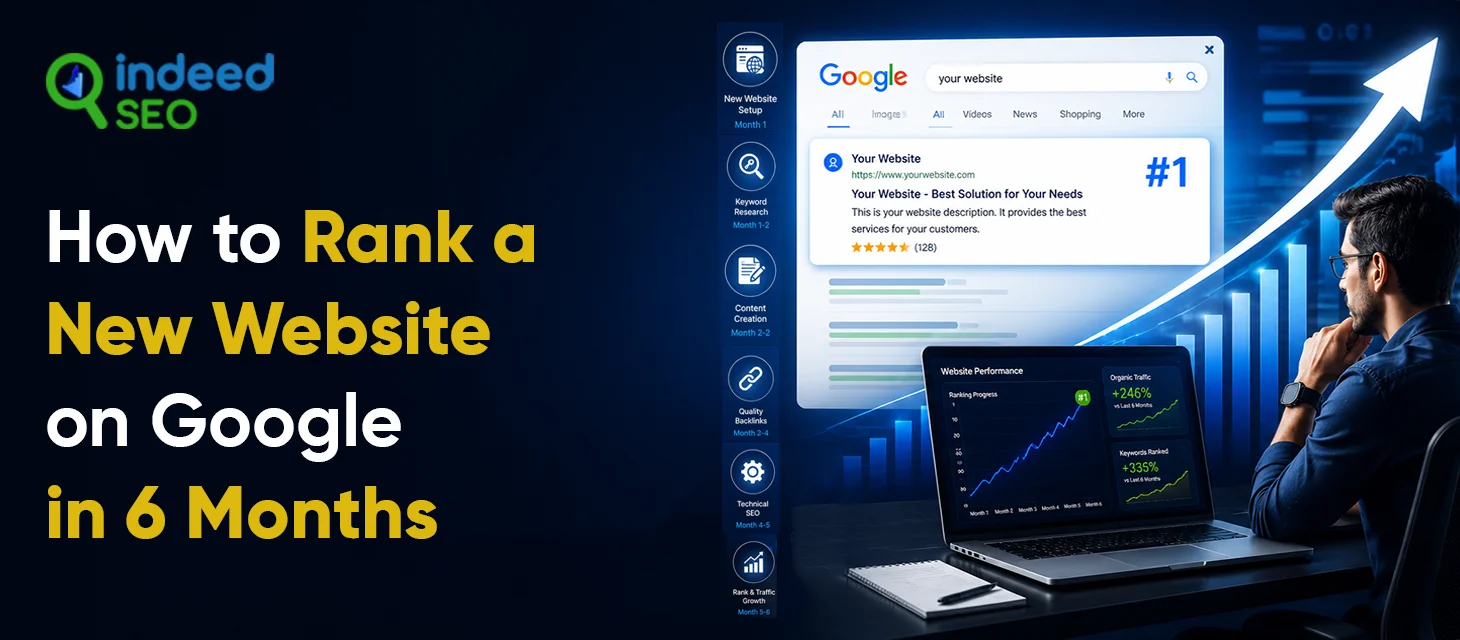
Ranking a new website on Google takes about 3 to 6 months. In this time, the brand can expect a brief initial engagement with stable traffic. The first-page rankings can be expected around the 6-month mark. In this time, businesses must build trust, fix technical issues, and publish quality content.
| Month | Primary SEO Focus |
|---|---|
| Month 1 | Build the SEO Foundation |
| Month 2 | Publish High-Quality Content |
| Month 3 | Build Website Authority |
| Month 4 | Expand Content Coverage |
| Month 5 | Optimize & Improve Performance |
| Month 6 | Scale Organic Growth |
SEO Activity Overview: Month By Month
Month 1 – SEO activities to perform
- Technical SEO audit
- Keyword research
- Website architecture
- Google Search Console
- Analytics setup
Expected Progress: Google starts discovering and indexing your website while establishing its initial SEO foundation.
Month 2 – SEO activities to perform
- Create service pages
- Blogs
- FAQs
- Optimise metadata
- Build internal links
Expected Progress: More pages become indexed, long-tail keywords begin appearing in search results, and topical authority starts developing.
Month 3 – SEO activities to perform
- Begin quality link building.
- Local citations
- Guest posting
- Optimize existing content
Expected Progress: Keyword rankings begin improving, domain authority strengthens, and referral traffic starts increasing.
Month 4 – SEO activities to perform
- Build topic clusters
- Target long-tail keywords
- Publish supporting content
Expected Progress: Google recognizes your website as a more authoritative resource, resulting in increased keyword visibility and organic impressions.
Month 5 – SEO activities to perform
- Update older content
- Improve CTR
- Optimize Core Web Vitals
- Add schema markup
Expected Progress: It improves the click-through rates and user engagement. With consistent efforts, the website can benefit from more stable rankings for competitive keywords.
Month 6 – SEO activities to perform
- Continue link building
- Publish expert content
- Optimize for AI Search
- Monitor rankings
Expected Progress: Consistent organic traffic growth with stronger domain authority. In the long term, it supports strong keyword rankings and automatically delivers targeted traffic to the business without further optimization.
Tips On How To Rank On Google Faster
Ranking on Google is a targeted process that requires a few months for stable results. By following the right SEO strategies, professional SEO agencies like IndeedSEO help websites gain more visibility quickly.
SEO Tips To Rank On Google Fast:
- Target low-competition, long-tail keywords first.
- Create helpful content that matches search intent.
- Publish fresh content regularly.
- Optimize content for AI Search and Google AI Overviews.
- Make your website mobile-friendly.
- Build internal links between related pages.
- Earn quality backlinks from trusted websites.
- Fix technical SEO issues regularly.
Consistent SEO efforts are required to build strong rankings. As your website gains user trust, Google automatically helps it get stronger rankings and steady traffic.
Start Building Long-Term Organic Growth Today with IndeedSEO
Conclusion
Ready to rank your new website on Google faster with a proven SEO strategy?
IndeedSEO helps new websites grow through data-driven SEO plans. Our SEO experts offer technical SEO, content strategy, AI Search Optimization, and authority-building services to help you achieve stable growth in rankings, qualified traffic, and online visibility within 3 to 6 months.
PakarPBN
A Private Blog Network (PBN) is a collection of websites that are controlled by a single individual or organization and used primarily to build backlinks to a “money site” in order to influence its ranking in search engines such as Google. The core idea behind a PBN is based on the importance of backlinks in Google’s ranking algorithm. Since Google views backlinks as signals of authority and trust, some website owners attempt to artificially create these signals through a controlled network of sites.
In a typical PBN setup, the owner acquires expired or aged domains that already have existing authority, backlinks, and history. These domains are rebuilt with new content and hosted separately, often using different IP addresses, hosting providers, themes, and ownership details to make them appear unrelated. Within the content published on these sites, links are strategically placed that point to the main website the owner wants to rank higher. By doing this, the owner attempts to pass link equity (also known as “link juice”) from the PBN sites to the target website.
The purpose of a PBN is to give the impression that the target website is naturally earning links from multiple independent sources. If done effectively, this can temporarily improve keyword rankings, increase organic visibility, and drive more traffic from search results.
Comments are closed, but trackbacks and pingbacks are open.